War Stories (learning from the past)
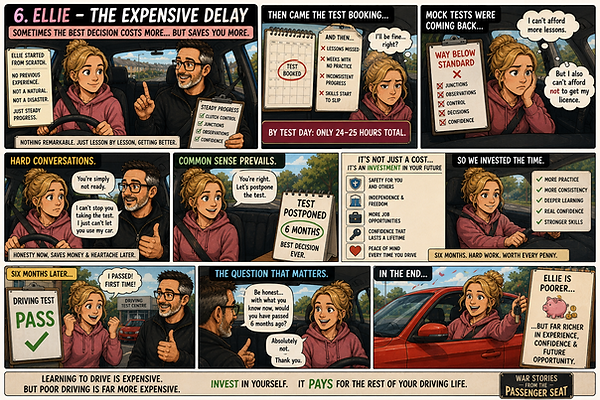
#6 — Ellie: The Expensive Delay
Ellie started exactly how most learners start.
No previous experience.
No dramatic talent.
No major struggles either.
Just steady progress.
Lesson by lesson she improved normally:
-
clutch control settled
-
junctions improved
-
observations became more natural
-
confidence slowly built
Nothing remarkable.
And honestly, that’s important to say because most learner drivers are not extreme cases.
Most sit somewhere in the middle:
not naturals, not disasters, just ordinary people learning a complicated skill over time.
Ellie was one of those.
Then came the test booking. And that’s where reality started creeping in.
Lessons became inconsistent.
A cancellation here.
A missed week there.
Sometimes two weeks passed with no driving at all.
Which might not sound catastrophic to non-drivers, but driving skill is heavily tied to repetition and recency.
If learning gaps become too large, progress doesn’t just pause.
Parts of it decay.
So instead of moving forward every lesson, we started spending time recovering old ground:
-
clutch bite drifting again
-
hesitation returning
-
observations becoming less automatic
-
confidence dropping
Meanwhile the clock kept ticking toward the driving test.
By the time we looked honestly at the situation, something uncomfortable became obvious:
She was likely going to arrive at test day with only around 24–25 hours total experience.
And the mock tests reflected it brutally.
Way below standard.
Not “might scrape through.”
Not “good day bad day.”
Below standard.
The difficult part was that money was clearly becoming a factor.
And that changes the emotional tone of lessons completely.
Because suddenly every extra lesson feels expensive.
Every recommendation feels personal.
Every delay feels financially painful.
Eventually Ellie said it outright:
“I can’t afford more lessons.”
Followed immediately by the real pressure underneath:
“But I also can’t afford not to get my licence.”
And honestly?
That’s one of the hardest conversations instructors ever have.
Because there’s a temptation — financially and emotionally — to avoid confrontation.
To soften reality.
To say:
“Maybe you’ll get lucky.”
But false hope is incredibly expensive in driver training.
A failed test costs money too:
-
test fees
-
more lessons
-
more waiting
-
more stress
-
damaged confidence
So eventually the hard conversation had to happen.
You’re simply not ready.
And I remember saying something very carefully:
“I can’t stop you taking the test.
I just can’t let you use my car.”
Which sounds harsh on paper.
But sometimes honesty is the kindest thing an instructor can give somebody.
Because deep down, Ellie already knew.
The mock tests weren’t lying.
The inconsistency wasn’t helping.
The gaps in skill were real.
Eventually common sense won the argument.
The test got postponed.
Six months.
At the time, it felt devastating to her.
Six months sounded enormous.
Expensive.
Embarrassing.
Frustrating.
But then something important happened:
The pressure disappeared.
And once the panic timeline vanished, the learning improved again.
Lessons became more productive.
Confidence grew properly.
Skills settled deeper.
Driving became calmer.
Not rushed.
Not forced.
Built properly.
Six months later Ellie was a completely different driver.
Not perfect.
But secure.
Comfortable.
Capable.
And when the next test finally arrived, she passed first time.
Comfortably.
No drama.
No miracle survival.
No lucky escape.
Just a genuinely ready driver completing a driving test successfully.
Afterwards I asked her something I already knew the answer to:
“Be honest… with what you know now, would you have passed six months ago?”
Her answer came immediately:
“Absolutely not.”
Then:
“Thank you.”
And honestly, that’s the hidden reality most people never see in driving instruction.
Sometimes the biggest value an instructor provides is not helping somebody take a test.
It’s helping them avoid taking the wrong one too early.
In the end Ellie got her licence.
She was definitely poorer.
Probably slightly traumatised financially.
But she also became something much more important:
A safe driver with real confidence.
And that lasts far longer than the money.